 Home
Home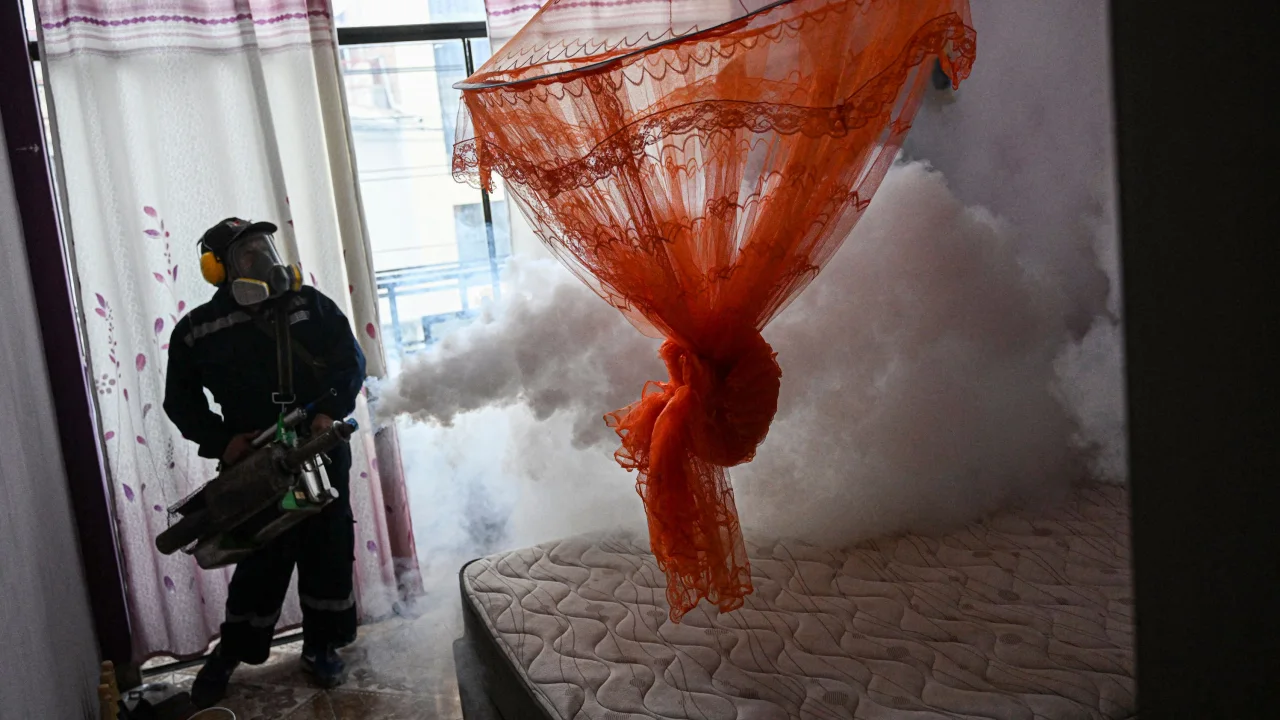
A worker fumigates a house against the Aedes aegypti mosquito to prevent the spread of dengue in a neighborhood of Piura, northern Peru, on June 11, 2023. Credit: Ernesto Benavides/AFP/Getty Images
(CNN) --
Dengue cases in America have registered an "exponential increase" in 2024, so countries must reinforce surveillance, prevention and care of sick people and actions to control the Aedes aegypti mosquito ( main transmitting vector), according to the most recent epidemiological alert from the World Health Organization (WHO) and the Pan American Health Organization (PAHO), issued on February 16.
This upward trend is similar to what occurred in 2023. That year, 4,565,911 cases and 2,340 deaths were recorded in the region, the highest record to date, according to the WHO and PAHO.
Both organizations estimate that the numbers may be even higher in 2024, since in the first days of February alone there were 673,267 cases and 102 deaths, they reported in a statement on February 20.
For this Friday, 1,131,155 cases and 207 deaths have already been registered, according to the WHO and PAHO platform that monitors the disease.
Why are there more cases of dengue?
The director general of the WHO, Tedros Adhanom Ghebreyesus, said on February 7 during a forum in Brazil - the country with the most cases in the Americas - that the expansion of dengue is occurring in all regions of the planet, with the exception of Europe, driven due to the El Niño climate phenomenon.
advertising
“In fact, this dengue outbreak (in Brazil) is part of a global rebound,” he noted.
Some specialists agree with this and state that climate conditions favor the proliferation in certain places of the Aedes aegypti mosquito, which transmits the virus that causes this disease.
“This occurs practically due to climate change and is enhanced by the El Niño phenomenon,” doctor Jorge Baruch Díaz Ramírez, head of the Travel Clinic at the National Autonomous University of Mexico (UNAM), told CNN.
Some factors that combine are droughts, unexpected rains, floods and migratory flows, which allow more mosquitoes and dengue to spread, he added.
Which countries have the most cases?
In all of America, the region that concentrates the most cases is the Southern Cone with 982,595, 86.9% of the total, according to the WHO and PAHO platform as of this Friday.
Within the Southern Cone, the country with the most cases is Brazil with 829,279 and 113 deaths, followed by Paraguay, with 131,454 cases and 24 deaths, and Argentina, with 21,850 cases and 19 deaths.
In the Andean region, Colombia and Peru stand out: the first has 40,662 cases and 4 deaths, and the second, 24,981 cases and 23 deaths.
Further north, Mexico has 26,561 cases and no deaths so far.
How to protect yourself from dengue?
The WHO and PAHO have called on countries to strengthen their epidemiological surveillance and their communication campaigns towards citizens.
The WHO director also recognized Brazil's efforts to start a vaccination campaign against dengue among the most vulnerable sectors of the population.
On Wednesday, Brazil's Ministry of Health announced the launch of an immunization campaign in schools.
Regarding what citizens can do, doctor Díaz Ramírez said that people should “trust that science is an ally” and get vaccinated against dengue if the authorities give them that possibility.
Other preventive measures, he explained, are to reinforce the placement of mosquito nets in homes, particularly in areas where people sleep, and to prevent places from forming where water can accumulate and stagnate, since these places are what favor the proliferation of mosquitoes.
In Mexico, for example, it is common for people in some rural areas to use old tires or tires to delimit their properties, but these points become spaces that welcome mosquitoes, said the specialist.
Preventing breeding sites like this from forming is key to stopping dengue, he added.
AmericaDengueDiseasesHealth information