 Home
Home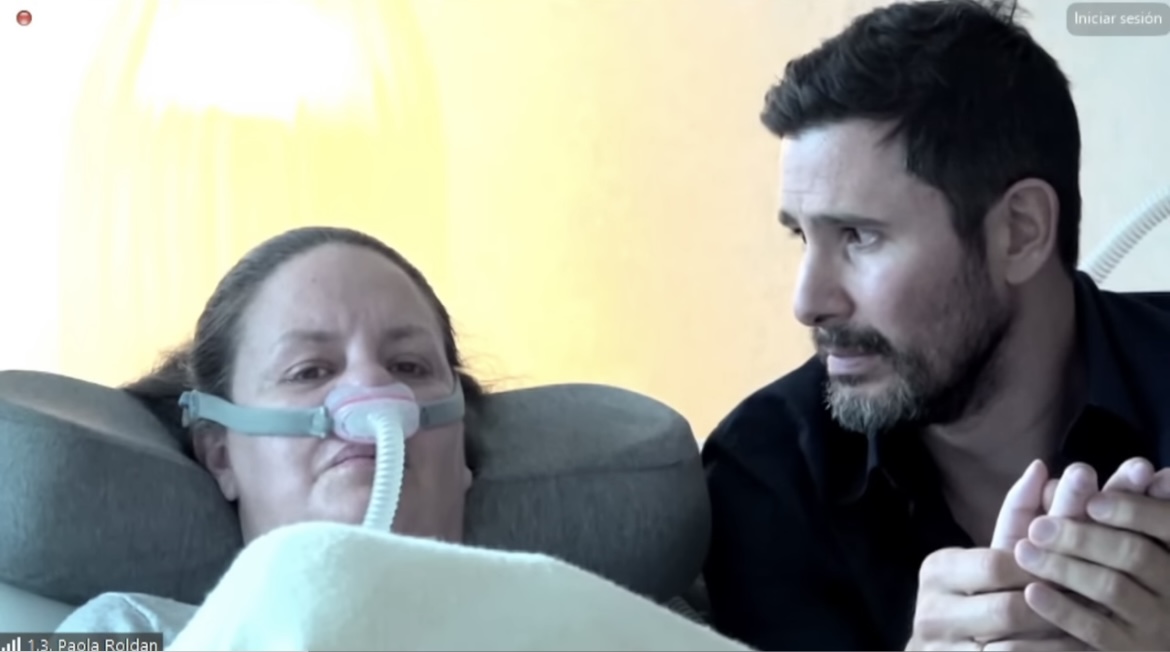
A patient with a devastating disorder seeks euthanasia in Ecuador 3:58
(CNN Spanish) --
The Constitutional Court of Ecuador approved the decriminalization of euthanasia after a five-month legal battle waged by Paola Roldán, a 42-year-old woman who suffers from amyotrophic lateral sclerosis (ALS).
In August 2023, Roldán filed a lawsuit for unconstitutionality of article 144 of the Comprehensive Penal Code, which threatened to prosecute anyone who helps a person who expresses their desire to opt for euthanasia for simple homicide. The lawsuit was admitted in September.
Roldán was diagnosed with ALS in 2020 and currently has a 95% disability, so she depends on a breathing machine, nursing assistance at home, palliative care and a hospital bed, among other resources for help.
“I received this news very moved and with relief. There were days when I thought I would never find a result of this lawsuit. “Today has been a very special moment for me,” Roldán said in a Zoom press conference with his lawyers after hearing the news.
“This decision of the Court to bet on solidarity, autonomy and dignity. “I will spend these days with my family and with my generous and brilliant attorneys digesting what this means,” he said.
"You cannot have a dignified life without a dignified death": Paola Roldán's fight for the legalization of euthanasia in Ecuador
The Constitutional Court in its ruling, which was released this Wednesday, declared the conditional constitutionality of article 144 of the Penal Code and clarified that it will be constitutional as long as active euthanasia is not sanctioned, that is, in the case in which:
advertising
-The doctor who carries out the conduct contained in the aforementioned rule will not be sanctioned.
-A person, expressing their unequivocal, free and informed consent (or through their representative when they cannot express it), requests access to an active euthanasia procedure due to the suffering of intense suffering resulting from a necessarily serious and irreversible bodily injury. or a disease that is serious and incurable
The Court clarified in its opinion that the right to a dignified life has two dimensions: subsistence and the concurrence of minimum factors that allow a “decent” existence.
The court considered that although the right to life in its dimension of subsistence is inviolable, “due to the circumstances related to euthanasia - intense suffering and request of the person holding the protected legal asset - the application of this measure in such cases is not punishable, in order to preserve the rights to a dignified life and the free development of personality.”
The Court established that this ruling “will have immediate effects as established in article 162 of the Organic Law of Jurisdictional Guarantees and Constitutional Control.
Said article on the effects of constitutional rulings and opinions states that “Constitutional rulings and opinions are immediately complied with, without prejudice to the filing of appeals for clarification or extension, and without prejudice to their modulation.”
Consulted by CNN, Paola Roldán's legal team stated that they are analyzing the document and whether they will request a scope or extension of the sentence.
The sentence was approved with 7 votes in favor and 2 saved votes from two judges who argued that the application of euthanasia in Ecuador conflicts with constitutional norms and the legal system.
Provisions to the Assembly and the Ombudsman's Office
The Court ordered that the Ombudsman's Office prepare, within a maximum period of 6 months, a bill that regulates the procedures for the application of euthanasia.
The Ministry of Health was given a maximum period of 2 months to develop a regulation that regulates the procedure for the application of euthanasia.
And finally, he ordered the National Assembly to approve a law within 12 months at the latest that regulates euthanasia procedures with the highest standards.
Paola Roldán's fight for a dignified death
In Ecuador, a deeply religious country, Paola Roldán opened a broad debate between those who defend life despite the pain of an incurable disease and those who believe that patients with a fatal diagnosis can make a decision about whether or not to continue their life.
At the beginning of January, Paola Roldán responded in writing to some questions from CNN through her legal team. Roldán insisted on his urgent desire to legalize euthanasia in the country.
“My particular case is pressing, given the progression of ALS and the possibility that my ability to communicate will be limited in the short term. The day I cannot express my will or am not allowed to decide when to end my life, I would stop exercising my freedom, I would lose my dignity. You cannot have a dignified life without a dignified death,” Roldán emphasized to CNN.
ALS "is a deadly type of motor neuron disease characterized by the progressive degeneration of nerve cells in the spinal cord and brain. It is one of the most devastating disorders affecting nerve and muscle function" , as defined by the Johns Hopkins Hospital, one of the most prestigious in the world.
Euthanasia – according to the Royal Spanish Academy of Language – is the "deliberate intervention to end the life of a patient with no prospect of a cure." While for the National Cancer Institute of the United States it is the "intentional termination of the life of a person suffering from an incurable or painful disease, at their request."
On November 20, Paola Roldán appeared via Zoom from her bed and holding her husband's hand, at the public hearing before the Constitutional Court, where she explained her case and her wish to die due to her illness. The judges of the Court listened to her reasons.
At the same hearing, different jurists, members of medical organizations and members of civil society presented their arguments for and against Paola's lawsuit.
euthanasia