 Home
Home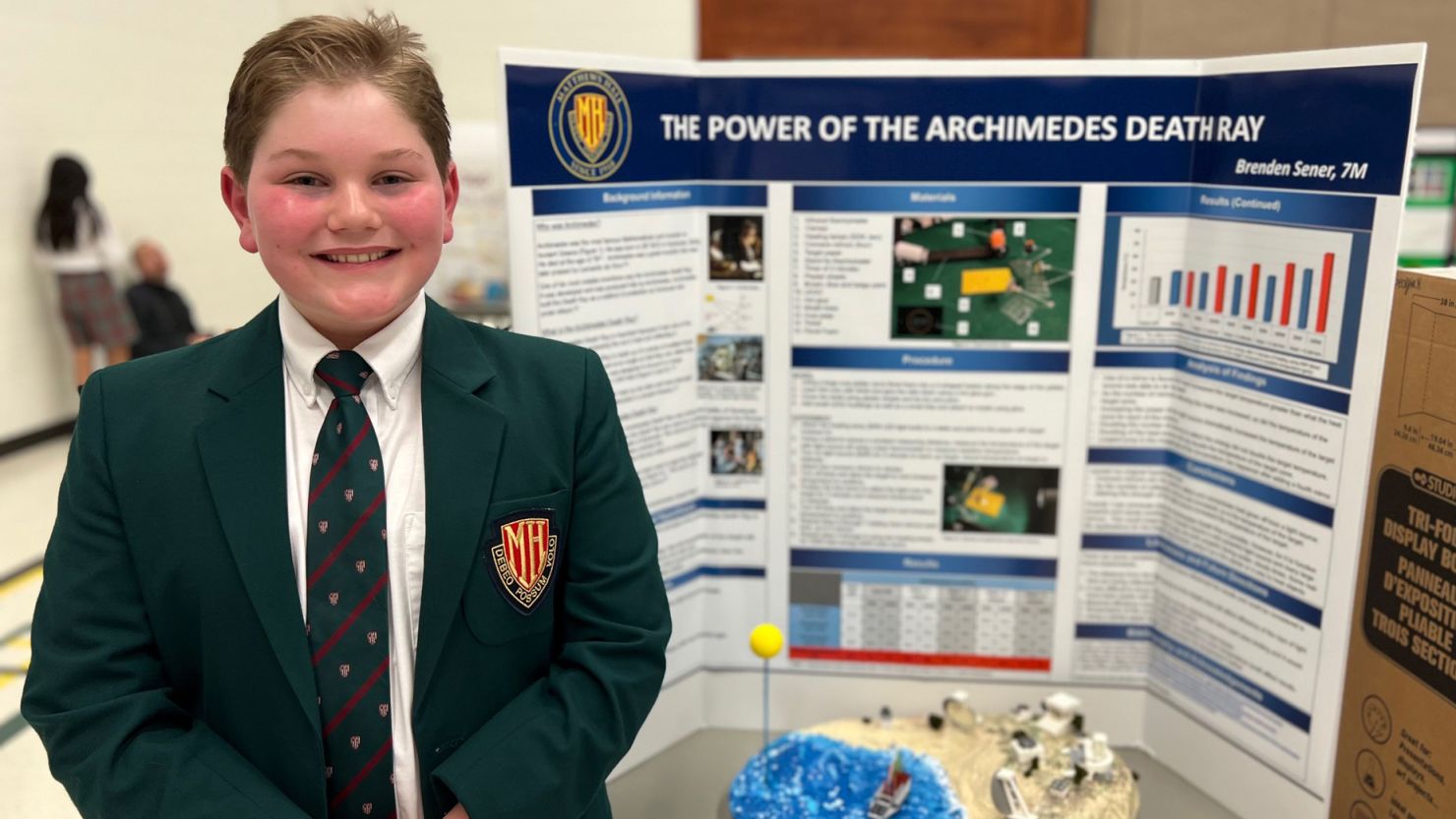
Brenden Sener, 13, from London, Ontario, created a miniature version of Archimedes' death ray for the 2023 Matthews Hall Annual Science Fair. (Courtesy of Melanie Sener)
(CNN) --
Archimedes, often called the father of mathematics, was one of the most famous inventors of ancient Greece, and some of his ideas and principles are still used today.
But there is one invention that left scientists speculating about its existence for hundreds of years: the death ray.
Now, a high school student may have some answers.
Brenden Sener, 13, of London, Ontario, won two gold medals and an award from the London Public Library for his tiny version of the contraption, a supposed weapon of war composed of a large series of mirrors designed to focus and direct sunlight towards a target, such as a ship, and causing it to burn, according to an article published in the January issue of the Canadian Science Fair Journal.
The Greek polymath fascinated Sener since he met the figure during a family vacation in Greece.
For his 2022 science project, Sener recreated the Archimedean screw, a device for lifting and moving water.
But he didn't stop there.
Sener discovered that one of the most intriguing devices was the death ray, sometimes called a heat ray.
Historical writings suggest that Archimedes used "burning mirrors" to set fire to anchored ships during the siege of Syracuse from 214 to 212 BC.
advertising
"Arquímedes was far ahead of his time with his inventions. And he really revolutionized the technology of the time, because Archimedes thought of things that no one had done before," explains Sener.
"(The death ray) is such an ingenious idea that no one at the time would have thought of it."
There is no archaeological evidence that the contraption existed, as Sener points out in his article, but many have attempted to recreate the mechanism to see if the ancient invention could be feasible.
A miniature death ray
In his attempt to make the beam, Sener placed a heat lamp in front of four small concave mirrors, each tilted to direct light onto a piece of cardboard with an X marked at the focal point.
In this project he designed for the 2023 Matthews Hall Annual Science Fair, Sener hypothesized that as the mirrors focused light energy onto the cardboard, the temperature of the target would increase with each added mirror.
In his experiment, Sener performed three tests with two different bulb wattages, 50 watts and 100 watts.
He discovered that each additional mirror noticeably increased the temperature.
"I wasn't quite sure how the results would turn out, since there are many different results on this topic, but I expected that there would be an increase in heat, although not as drastic as what I discovered when I performed the experiment," explains Sener.
A miniature death ray
In his attempt to make the beam, Sener placed a heat lamp in front of four small concave mirrors, each tilted to direct light onto a piece of cardboard with an X marked at the focal point.
In this project he designed for the 2023 Matthews Hall Annual Science Fair, Sener hypothesized that as the mirrors focused light energy onto the cardboard, the temperature of the target would increase with each added mirror.
In his experiment, Sener performed three tests with two different bulb wattages, 50 watts and 100 watts.
He discovered that each additional mirror noticeably increased the temperature.
"I wasn't quite sure how the results would turn out, since there are many different results on this topic, but I expected that there would be an increase in heat, although not as drastic as what I discovered when I performed the experiment," explains Sener.
The temperature of the cardboard during the experiment with only the lamp and the 100-watt bulb and without mirrors was about 27.2 degrees Celsius.
After waiting for the cardboard to cool, Sener added a mirror and did the test again.
The focal point temperature increased to almost 34.9 degrees Celsius.
The biggest increase came when adding a fourth mirror.
The temperature with three mirrors pointed at the target was almost 43.4°C, but the addition of a fourth mirror increased it by about 10°C to 53.5°C.
In the article, Sener states that he finds these results "quite remarkable, since they suggest that light goes in all directions and that the shape of the concave mirror focuses the light waves towards a single point."
Cliff Ho, chief scientist at Sandia National Laboratories, said the project is "an excellent assessment of fundamental processes."
This facility is a scientific and engineering laboratory of the US Department of Energy's National Nuclear Security Administration in Albuquerque, New Mexico.
Although the experiment does not offer "anything significantly new to the scientific literature (...), its findings were a nice confirmation of the first law of thermodynamics," which states that energy or heat can be transferred, Ho said.
The scientist had proposed a conference in 2014 on the death ray, concluding that the idea was possible but that it would have been difficult for Archimedes to carry it out.
Sener did not intend to set anything on fire, since "a heat lamp does not generate anywhere near the heat that the sun would generate," he said.
But he believes that with the use of the sun's rays and a larger mirror, "the temperature would increase even more dramatically and at a faster rate" and "would easily cause combustion."
More theories about the death ray
Every two years, the Olympic torch is lit using a curved parabolic mirror that concentrates sunlight to one point.
Once the torch is placed at that focal point, the sun's rays light it.
It is not believed that Archimedes used a single parabolic mirror, since it cannot be pointed in the same way as a plane mirror.
It is most commonly speculated that Archimedes' death ray was an assembly of several polished mirrors or shields.
However, this theory is often discredited due to the idea that the ships would be moving during the battle.
According to Thomas Chondros, a retired associate professor in the Department of Mechanical and Aeronautical Engineering at the University of Patras (Greece), for the ships to catch fire from the heat generated by the mirrors they would have had to be stationary and anchored near the coast.
Chondros has studied Archimedes and his inventions.
The Discovery Channel series "MythBusters" aired episodes in 2004, 2006 and 2010 testing scenarios for the supposed death ray, but ultimately declared the legend a myth when each test failed to set it on fire. to a wooden boat.
In 2005, a group of students from the Massachusetts Institute of Technology, inspired by the first episode of the series, managed to set fire to a wooden boat with a technique similar to Sener's on a larger scale, but failed in a second attempt.
Despite the limitations to the viability of the death ray, Chondros considered that Sener's project was "interesting and well documented," and the teenager's experimental setup could "form the basis of a debate for young students, even university students." "he said in an email.
Sener's mother, Melanie, was not surprised that her son chose a science project.
"She has always been fascinated by history, science and nature. (...) she has always had a thirst for any form of education and knowledge," she said.
Sener sees himself one day being a scientist, whether in engineering, bioengineering or medicine, he said.