 Home
Home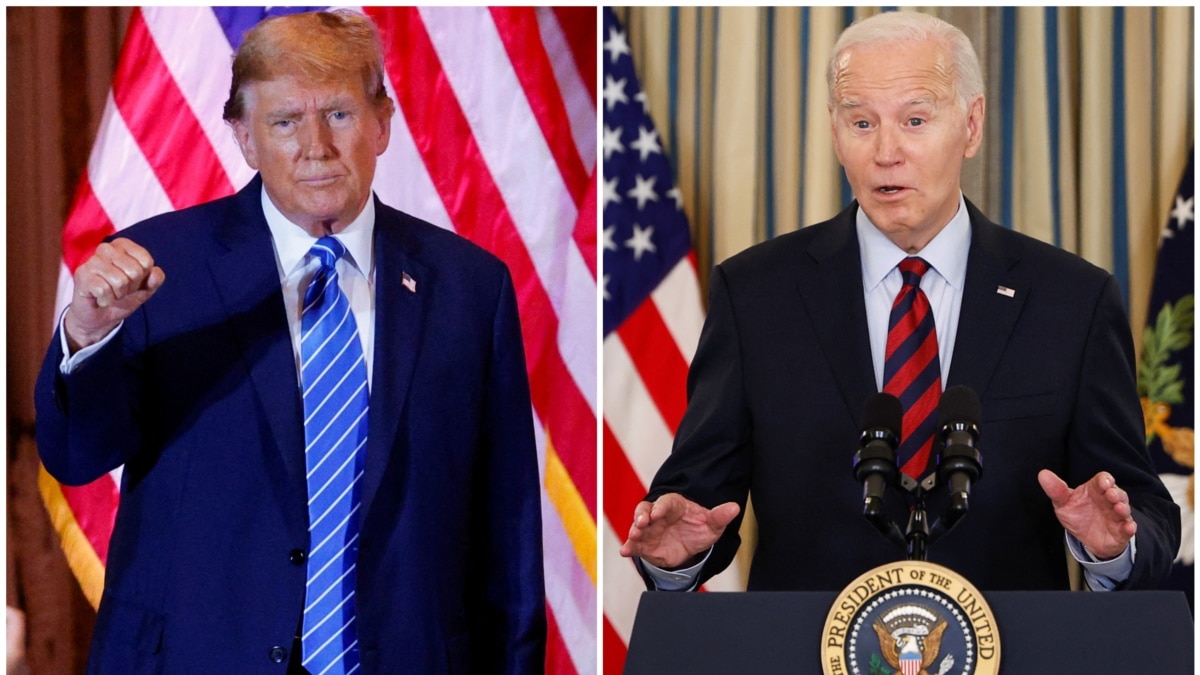
Andrei Karabkov , professor of political science at the University of Tennessee (USA), answers
these questions of
Yuriy Drakakhrust
.
- During the voting in the USA on Super Tuesday, former President Donald Trump won 13 out of 15 states in the Republican Party with a large margin. President Joe Biden, who is running for a second presidential term, convincingly won in all states.
Did the vote on Super Tuesday decide who the Democratic and Republican candidates will be?
Andrei Karabkov
— Yes, it was just announced that
Nikki Haley
has decided to withdraw from this race, so
Donald Trump
becomes the only candidate.
In fact, he was the only real candidate, but now it is already being done officially.
Everything is easier for the Democrats, because
Joe Biden
received more than 90% of the votes in the primaries.
Although in two states with significant Muslim populations, Michigan and Minnesota, a large share of Democrats (about 13% in Michigan's case, almost 20% in Minnesota's case) voted for an abstract candidate, that is, they left their party delegates with free mandate.
They can vote for anyone.
And this was a very clear signal to Biden that a significant part of the democratic base opposes his policy in relation to Israel and Gaza.
But in general, it is quite clear that both parties have crossed the river and it will be very difficult for them to play back.
Moreover, in the case of the Democrats, Biden has the full support of the party establishment, although there are very serious warnings, which no one even hides, regarding his condition - both physical and mental.
The latest poll showed that 61% of Democrats believe that Biden is not fit to be president.
Nevertheless, the democratic elite supports him, and the democratic base as a whole accepted him as a candidate.
In the case of Trump, the situation is completely reversed.
About 20% of Republicans strongly oppose Trump.
At the same time, the top of the party, traditional Republicans, traditional conservatives, one might say, simply hate him.
But nevertheless, they cannot do anything about the ordinary members of the party, who support Trump not just by voting, but with enthusiasm.
- Were there any surprises on Super Tuesday?
- There were differences in voting between states.
In a number of southern states, in Texas, in Oklahoma, in Alabama, more than 60 points separate Trump from Haley.
That is, there is a huge gap.
In a number of states, it is not so large, and this is primarily the case in the northeastern states.
In Virginia, the margin is less than 30 points, and in Vermont, Nikki Haley won.
Which, in general, is not surprising, given the composition of the population and the fact that this state has for a long time elected to the Senate
Bernie Sanders,
a socialist senator who formally aligns with the Democratic faction in the Senate, but who himself declares that he is independent and under this socialist.
Nikki Haley also won the Washington primary.
Washington is a very specific place.
Republicans there usually get less than 10% of the vote, and even that small group of Republicans who live directly in Washington is very specific.
They are closely connected with the Republican elite, with neoconservatives, these are often those Republicans who served in the government of the Republican president, and now they are just sitting around waiting for some changes in the White House.
And at the same time, Trump, of course, does not satisfy them at all as a president, because he recruits his own people, and they, naturally, would like to get into a new team.
There are a lot of lobbyists, there are many officials who are not Trumpists.
They support the traditional Republican elite, embodied by Nikki Haley, and with her departure, they lose hope that a Republican candidate can represent their interests.
At the same time, it was already clear that Trump would get the nomination, that he was far ahead, but there was at least a formal reason to believe that he had a competitor and to hope for some abstract changes.
Now there are no such hopes.
Nikki Haley, by speaking out against Trump, using increasingly harsh rhetoric against him, has to some extent committed political suicide.
Her calculation was that something would happen to Trump, that the courts would remove him from the election, something else would happen, and then she would be the candidate of the party.
This did not happen, because the absolute majority of rank-and-file Republicans are now Trumpists.
And Nikki Haley for them is not only an abstract ideological opponent, she is now a traitor.
Not only will she not be nominated this year, but in four years she will have very big problems if she decides to participate in the primaries.
— After the 2022 midterm elections, the opinion was expressed that the dominance of the Republicans in the House of Representatives will not change the US policy towards Ukraine. But Trump is not yet the president, and it is not known whether he will be, and this policy has already changed. Why? What was not taken into account in the hypotheses of 2022 that it will not change until the presidential elections?
- The fact is that the republican faction was considered as a single entity.
But it was the fact that the Republicans had a minimal advantage over the Democrats in the House of Representatives that dramatically strengthened the power of Trump and Trumpists, since all members of the Republican Party must vote in solidarity for a certain decision.
The loss of even a few votes leads to ungovernability of the Republican faction.
At the moment, the ratio is 219 Republicans to 213 Democrats, and this, in fact, means that if two or three people leave, the decision cannot be implemented.
This made the speaker — first
Kevin McCarthy
, and now
Mike Johnson
— complete hostages of Trumpists.
The faction in the House of Representatives itself is split roughly in half: half are traditional Republicans, and half are Trumpists.
Out of these Trumpists (about 100 people), about 10 people are irreconcilable, who do not make any compromises either with the Democrats or with the leadership of their faction.
So the speaker, Mike Johnson at the moment, knows that he could pass the resolution on Ukraine with the votes of the Democrats and some of the Republicans, but if he does, he will commit political suicide, because the extreme Trumpists, let's call them that, then they will drown him. .
They will vote against him, and the House will again be without a speaker.
Therefore, what was perceived as a very big success for the Democrats during the 2022 elections, that they retained control of the Senate and almost won half the seats in the House of Representatives, was actually a victory for the Trumpists.
Trump has always taken a very tough position both in relation to Ukraine and in relation to
Zelensky
.
He believes that the USA should play the Russian card, that is, try to weaken China first, and therefore have some kind of relationship with Putin.
But, apart from that, it is also a matter of tactics.
In this situation, Ukraine turned out to be a hostage of American internal political and even intra-party quarrels.
- If Trump becomes president, how can the policy of the United States change in relation to the war and Russia? Trump will not give money to Ukraine, will he agree to recognize certain Ukrainian territories for Putin? Yes?
- I think that the policy regarding Ukraine will become tougher.
The amount of aid will be reduced, and the money will go only to military needs, that is, no financial aid to cover Ukraine's budgetary needs.
But in general, politics will continue, oddly enough.
Modern politics is based on the strategic interests of the USA, and there is an understanding that Trump is now playing a tactical game.
That is, it is not so much about Ukraine, but about his power, his ability to pursue his course, which differs from Biden's course.
47 billion dollars are directly military needs, military aid, and about 14 billion are other issues, including support of the Ukrainian budget.
And I think that if Trump came to power, these 14 billion would be cut, strict conditions would be set regarding the use of these funds, reporting on their use.
But military aid would still be allocated, because as soon as a person comes to the White House, no matter what rhetoric he demonstrated before, he begins to think about the strategic interests of the country.
It is one thing to sabotage the policies of the president sitting in the White House, and it is quite another to think about the results of your policies and the impact of these policies on your popularity.
Therefore, I think that the irony is that in general the policy would be preserved, aid would be resumed, but on stricter terms.
Trump says that money can be given, but it should not be some kind of grants, it should be loans that must be returned and, perhaps, received as collateral for some objects on the territory of Ukraine.
— Trump said that he could very quickly achieve peace in Ukraine. It sounds like hyperbole, to say the least. But if this is real, then it seems that only with territorial concessions on the part of Ukraine. Is Trump ready for it, is he actually talking about it?
- I think so.
But I think that, most likely, the formula will be Russia's preservation of control over Crimea.
Most likely, also maintaining control and spreading control over the entire territory of the Donetsk and Luhansk regions within the administrative borders of Ukraine.
But perhaps pressure will be put on Putin to leave Zaporozhye and the Kherson region.
But this, of course, is done to some extent by divination on coffee grounds.
Trump will need to reach some sort of compromise, to demonstrate that he can actually get a result.
He will say that he is a peacemaker who pressured Putin and forced him to make some decisions.
But what this formula will be will be determined not so much by Trump and his wishes, but by the situation on the battlefield.
That is, those where both Russian and Ukrainian troops will be located at that moment (which is specifically on January 20, 2025, when the US president takes office).
- US relations with Belarus are largely derived from the relations between Washington and Moscow. If the policy towards Russia changes under President Trump, what will its Belarusian derivative be?
- When we discuss foreign policy, we must first remember that Trump is a classic realist.
Before him, the most realistic president in the academic and political sense was
Richard Nixon.
As we know, Nixon made a deal with China to weaken the Soviet Union.
Trump's advisers, first of all
Steve Bannon
, say that it is necessary to reach an agreement with Putin in order to weaken China.
This is the key question.
Political realism implies that you don't care at all about things like morality, like ideology.
You proceed only from concepts of strength and do what is beneficial to you.
Trump's policy will largely be determined by this.
He does not care at all about the political regime in a certain country.
He is concerned about whether, from his point of view, this country is beneficial for the United States and whether some kind of dialogue with it is necessary.
Therefore, the obstacles that
both the Europeans and Biden have for dialogue with
Lukashenko will be insignificant for Trump.
And, of course, he will try to somehow play the Belarusian card, including against Russia.
And, knowing Lukashenka's approaches and political methods, of course, it can be assumed that he will gladly return to the role of a positional player who maneuvers between different political centers of power.
- America's desire to reduce Russia's influence on Belarus has always been an important component of US policy towards Belarus. Will President Trump care?
- I think so.
I think that Lukashenka found himself in an unpleasant situation when he became Putin's hostage in connection with Ukraine, in connection with sanctions, and before that, of course, in connection with the elections.
And I think that Trump will definitely offer him the role of a mediator again, a player who can get something for independence or, let's say, flexibility of his actions.
And I think that the situation will develop in this direction, if, of course, Trump is in the White House.
— Under the Biden administration, communication was established between the American authorities and the democratic forces of Belarus, called a strategic dialogue. You talked about its content in an interview with Svaboda. Will this dialogue continue under President Trump?
- Yes, it will be preserved, and the aid channels will also be preserved.
- We talked more about Trump. But let's assume that Joe Biden will be re-elected as president. By default, it is assumed that in this case he will continue the policy of his first term. And is it so? After all, Biden can start pursuing a different policy.
- It is possible.
Usually, when the president is re-elected for a second term, there is a big change in his team.
Very serious changes have already taken place during the years of Biden's presidency.
White House chief of staff
Ron Klein
, who was very close to him, left.
Susan Rice
, who played a key role under both
Obama
and Biden,
has left , although under Biden she switched to domestic politics.
Maybe some serious changes will happen now.
At the same time, not only the result of the presidential elections is important.
A new balance is important in both the Senate and the House of Representatives.
It is possible that Biden, if re-elected, will proceed from the need to ensure his place in history.
That means to achieve some key foreign policy results.
And this may cause policy revision in certain regions.
It is difficult to say whether he will try to strengthen military support for, say, Ukraine or, on the contrary, push Zelensky to some dialogue with Moscow.
But one must keep in mind that American public opinion is slowly but surely changing.
And Trump expresses the views of a large part of the electorate.
This group of the electorate believes that it is necessary to pay more attention to domestic problems and spend less on foreign aid.
One of Trump's slogans is to force the Europeans, members of NATO, to at least pay what they have agreed to pay, namely, at least 2% of their GDP for defense needs.
Now, far from all the countries of the Alliance fulfill this obligation, only Great Britain is among the major countries.
Naturally, there will be pressure on the Europeans, even if Biden is the president.
In addition to Ukraine, there is a problem with Israel, because something happened there that no one expected at all.
According to the latest data, two-thirds of young Americans between the ages of 18 and 34 supported Gaza.
And it turned out to be a shock for the political establishment and for Biden.
I personally do not rule out that by November, before the elections, Biden may become practically incapacitated.
And any other lawsuits may be filed against Trump.
And since he is still perceived as a systemic threat, everything will be done to prevent him from winning.
Yuri Drakakhrust
Radio Svaboda journalist
drakakhrusty@rferl.org
FACEBOOKSubscribe