 Home
Home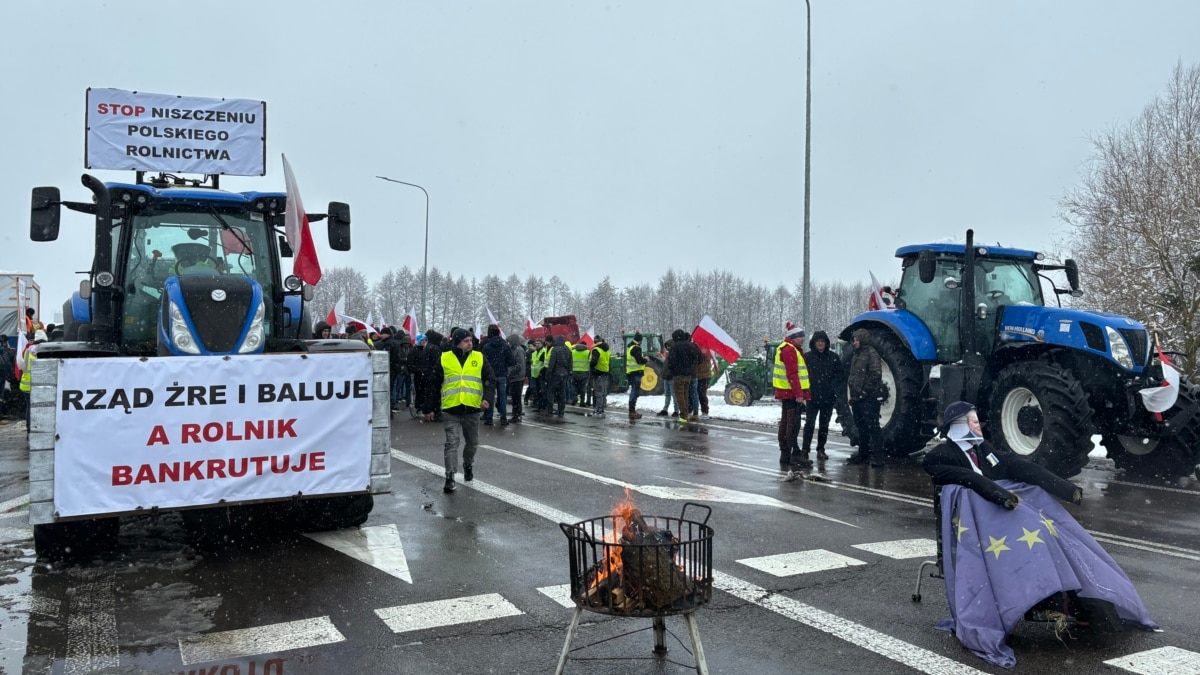
At first, traffic was stopped by Polish carriers, who demanded the restoration of permits canceled for Ukrainian carriers after the Russian military invasion in February 2022. In the conditions of closed airspace and sea routes, the land border has become the only logistics through which Ukraine receives military aid from the West - equipment, weapons and shells.
It is noteworthy that at that time Polish transporters blocked traffic not only for export of products from Ukraine, but also for import into Ukraine. Even a delegation from Lithuania went to Poland to clarify the situation, worried that their help was not reaching the Ukrainian front. At the end of December, the situation was resolved and unblocked, although they tried to extend it to Ukraine's borders with other EU countries, Slovakia and Romania. Several Ukrainian drivers died while waiting for the opportunity to cross the border.
Now Polish farmers have begun to block the roads leading to the Ukrainian border. The main demand is to stop the import of Ukrainian grain and at the same time cancel the environmental and climate restrictions introduced within the European Union. And when protesting transporters stopped only freight transport, farmers began to block passenger buses and railway transport. Grain became the main weapon - it is simply dumped on the road.
Svoboda collected information about what is happening on the Polish-Ukrainian border.
The Ukrainian authorities called the situation a political provocation
The authorities of Ukraine avoid harsh assessments of the situation and try to unblock traffic on the border through negotiations. A day ago, the stoppage of a passenger bus and a train forced the Vice-Prime Minister of Ukraine, the Minister of Infrastructure,
Alexander Kubrakov
, to contact the head of the National Security Bureau of Poland,
Jacek Sever
.
The representative of the Ukrainian government called these cases "examples of inhumane treatment of Ukrainians at the border of the European Union", which can be used by Russian special services to resolve an artificial conflict between Ukraine and Poland.
Later, Aleksandar Kubrakow accused the Polish farmers who stopped the freight train and dumped Ukrainian grain from the freight train, which was transiting to Germany, of political provocation.
Protest action of Polish farmers
Ukrainian President
Volodymyr Zelensky
said that only 5% of Ukrainian agricultural exports pass through the Polish border.
"Actually, the situation is not about grain, but rather about politics. And near Kupyansk, not far from the border with Russia, where the enemy's artillery does not stop, the news from the border with Poland just looks like a mockery. Community decisions, rational decisions are needed to get out of this situation. Our decisions are with the Poles first, and with everyone in Europe who is worried about the fate of Europe," Uladzimir Zelensky said.
Now, in several directions, Ukrainian carriers have begun to block the entry of Polish trucks into the territory of Ukraine.
What the Ukrainian media write
Since the beginning of the year, the Ukrainian mass media have been writing about the "trade war between Poland and Ukraine", which was the result of the election and post-election situation, when the previous government of Poland did not want to resolve the situation on the border with Ukraine in order to leave a "worse legacy" to its successors.
The new Polish government, formed
by Donald Tusk
, is in no hurry to radically stop the protests at the border, as it needs the support of farmers before the local elections.
"Европейска правда" published a criticism of Donald Tusk, who refused to support the initiative to introduce a ban on blocking the roads to the border with Ukraine during the war and started negotiations with the protesters.
"This approach made the Ukrainian border a convenient target. And more often we are not talking about conscious agents of the Kremlin (although there are enough of them in the "Confederation"), but about "useful fools" who are destroying Ukraine's relations with Poland, without even realizing whom they are helping with their actions," the editorial of the publication notes. .
According to the authors of the publication, the Ukrainian border has become a "reliable mechanism of pressure on the Tusk government, so soon the farmers may be joined by "other political players."
Ukrainian media call the actions of Polish farmers "cynical antics" and pay special attention to the anti-Ukrainian slogans that began to appear among the protesters.
Road blocking near Lublin, Poland, February 20, 2024
But most often in Ukraine they discuss the topic of Russian involvement in the organization of protests in Poland. Former intelligence officer of the KGB of the USSR and the Foreign Intelligence Service of Russia,
Oleg Zhirnov
, in an interview with the project of the former Deputy Minister of Information Policy of Ukraine,
Tatiana Popova,
expressed the opinion that this is a "special operation".
"There are no accidents in such matters. The situation is much more complicated, objectively more complicated," said Oleg Zhirnov.
As an argument, he told how in the 1980s, the illegal intelligence of the KGB of the USSR planned diversions in case of a military situation with Western Europe.
"This was planned even under the Soviet Union, the KGB planned. We had such a "Pennant" group in the illegal intelligence service, which was tasked with the task, when a military or pre-war situation arises in Western Europe, sabotage-intelligence groups are disembarked, which will block all of Europe, all rail transport and automotive," said Oleg Zhirnov.
According to him, at that time, with the help of the communist parties, "hideouts" were created with explosives, which had to be used to blow up railroads and highways.
"My boss
Drozdov, Yury Ivanovich
, said that with a squad of 30 specially trained people, who use explosives in hiding places, already planted with the help of the communist parties of the respective countries, they can put the whole of Western Europe on alert within a week. Now computer capabilities have been added, it is not even necessary to be physically present in Western Europe, it is enough for a group of hackers to "cut" all the computer connections that control transportation, even through border points and customs," noted the former Soviet and Russian spy.
Oleg Zhirnov added that Russia can use "real people, agents of influence, infiltrated into political parties or trade unions. In this context, he mentioned the situation in France, when the so-called "yellow vests" came out with protests, among them were people from Donbass, and who cooperated only with Russian propaganda TV channels, and the cameras of French and foreign media were smashed.
"Actually, this is quite a serious thing, which should not be treated with a smile," - summed up Oleg Zhirnov.
The protest did not start from the border
Polish farmers' strikes are not directed against the Polish government or the Polish Ministry of Agriculture. The main demand of the strikers concerns the agrarian policy of the European Union. According to farmers, the introduction of further restrictive rules for European agriculture is killing it.
Farmers in many EU countries have the same opinion, who have been taking to the streets for several weeks and demanding, among other things, a complete rejection of the "Green Deal" of the EU, as they are afraid of the consequences of its introduction.
For example, according to the GAEC 8 standard (this norm applies to farmers whose arable land occupies an area of more than 10 ha. — RS), farmers are obliged, among other things: to allocate at least 4 percent of arable land to non-productive (non-productive) area and elements .
In addition, farmers from different countries of the world add additional problems specific to their market to their postulates. Thus, Polish farmers, for example, additionally demand to preserve animal husbandry in the country, to extend the ban on the import of certain goods from Ukraine, and to tighten the control over the products imported into the EU.
The general Polish strike began on February 9 and will continue until March 10. Protests can cover the whole country, so traffic problems are predicted in all voivodships: the femres promise to block local and national roads.
"This form of protest is a cry of farmers for the Polish government to remind the European Commission about Polish agriculture. This is an uncontrolled influx of grain and food products in general from Ukraine, as well as eco-schemes that force farmers to close down and reduce their farms," Tomasz
Obszhansky,
chairman of the Independent Self-governing Farmers' Union "Solidarity", told Radio Warszawa about the reasons for the demonstration.
Last week, Polish farmers discussed their demands with the Minister of Agriculture and Rural Development
Czeslaw Syakerski
. The official agreed with their argument in many respects, but at the same time emphasized that it will not be possible to completely escape the requirements of the "Green Agreement".
The minister also informed that the Polish side is conducting negotiations with Kyiv on the conclusion of a bilateral agreement on establishing rules for determining the volume of quotas of individual agricultural products that can be imported from Ukraine to the Polish market and not disrupt its stability.
Earlier in the Polish agricultural community, opinions were voiced that cheaper agricultural goods from Ukraine will displace primarily Polish products from foreign markets. Concerns were also expressed that in the event of Ukraine's entry into the EU, selling prices for agricultural products will decrease, as a result of which the Polish farmer will have nowhere to sell his goods.
Polish manufacturers are outraged that they have to adapt to restrictive and expensive quality standards that do not apply to Ukrainian manufacturers.
This question is also addressed to Brussels, because Poland - as a participant of the open and duty-free EU market - does not have the prerogative to introduce rules in this sphere.
"The current regulations coming from Brussels favor Ukraine. We ask ourselves: does the European Union want to protect its own or promote someone else's? What goes from Ukraine to the Polish market is of very low quality. And there is no information on the products that they are goods from Ukraine, Poles buy them unknowingly. We are protesting to give publicity to this, so that Polish consumers do not have to consume lower-quality food,"
Antoni Sidar
, a farmer from Lubartowice in the Lublin Voivodeship, the local coordinator of Friday's demonstrations, told the Forsal portal.
Pro-Russian forces took advantage of the protest
In some places, the protests of Polish farmers acquired an anti-Ukrainian and pro-Russian character. In particular, the Polish mass media found out that two of the three leaders of the protests (leaders of the actions
Roman Kondruw, Rafal Mekler, Hubert Aidana
) are connected with the right-wing party "Confederation of Freedom and Independence".
Not all protesters like it. One of them believes that "the political influence among the farmers of Subcarpathia is becoming stronger and causing great damage."
"This is not our direction. We want to go the other way. Radicalism only harms us," one of the farmers told money.pl.
During farmers' protests on February 20, one of the participants took out a poster "Putin, deal with Ukraine, Brussels and our leaders." The police and the Minister of Internal Affairs of Poland,
Martin Kerwinski,
have already reacted to this . He emphasized that such criminal acts are unacceptable, the farmer who protested with this slogan was detained.
What is known about the leaders of the protest
Rafal Mekler
is the head of the Subcarpathian structures of the Confederation and an activist of the National Movement. As an entrepreneur, he works in the field of transport and has a company registered in the province of Lublin Voivodeship. Meckler is accused of anti-Ukrainian sentiments and supporting business contacts with entities from Russia.
Mekler himself denies the accusations, stating that he feels persecuted. "Ukrainians write to me in messages that they will kill my children. I was included in the Ukrainian list of enemies of my country," he said in an interview with Wirtualna Polska. He was included in the well-known base of the organization "Peacemaker" in Ukraine.
Hubert Aidana
is a farmer from the vicinity of Hajnavka in Podlasie, a member of the "Karona" farmers' union.
Aidan's previous activities are controversial. There are screenshots of messages on the social network X (formerly Twitter) in which he allegedly wrote that "Russia's victory over Ukraine is beneficial for Polish farmers." However, it was not possible to confirm the authenticity of the publications.
Now Aidan said that "Ukrainians need to be helped" and that after the Russian invasion he took in two families of refugees.
Reactions in Poland
The reaction of Polish citizens to the farmers' protests is insignificant. Some Poles are calling on the new government to deal with the situation on the Polish-Ukrainian border, which is only getting worse every day.
"I can't understand what they do and who controls them," wrote
Pyotr Andrusechka
, a Polish-Ukrainian journalist and freelance correspondent for Gazety Wyborczej .
"For ten days, I have been perplexedly watching the maneuvers of the "detachments of Polish farmers" on the border with Ukraine. I tried to understand their logic, their interests. Reading the Polish comments on social networks, I assumed that I might be biased, that I might be missing something, since I haven't lived in Poland for more than 10 years. But no, I can't figure out what they do and what controls them. One of their demands concerns Ukraine directly, and the rest of the demands are addressed to Brussels and Warsaw, but they block the border with Ukraine. Well done! It is very daring to dump grain from trucks and even stop a train and a bus with passengers. What's next?
I understand protests in defense of one's interests, this is an important mechanism in democratic countries, but also the adequacy of form and time is important. And now it seems that the blockade is a blow to the back of the country and its inhabitants, who are fighting the Russian aggressor for the second year. Soldiers die every day at the front, civilians die in towns and villages. Thanks to this, Europe and its inhabitants can not worry about the Russian threat for now. Was there no other form of protest?
I understand that there is politics involved. But Russia is also in the background and it doesn't matter that it is not directly behind it. What is happening on the border is part of Russia's hybrid activities... I could write a lot more, but for me it is just a shame and a shame. That's how this blackout will be remembered. And its consequences are already much greater than the interests of Polish farmers."
For sensitive topics,
write to us here.
SAFE