 Home
Home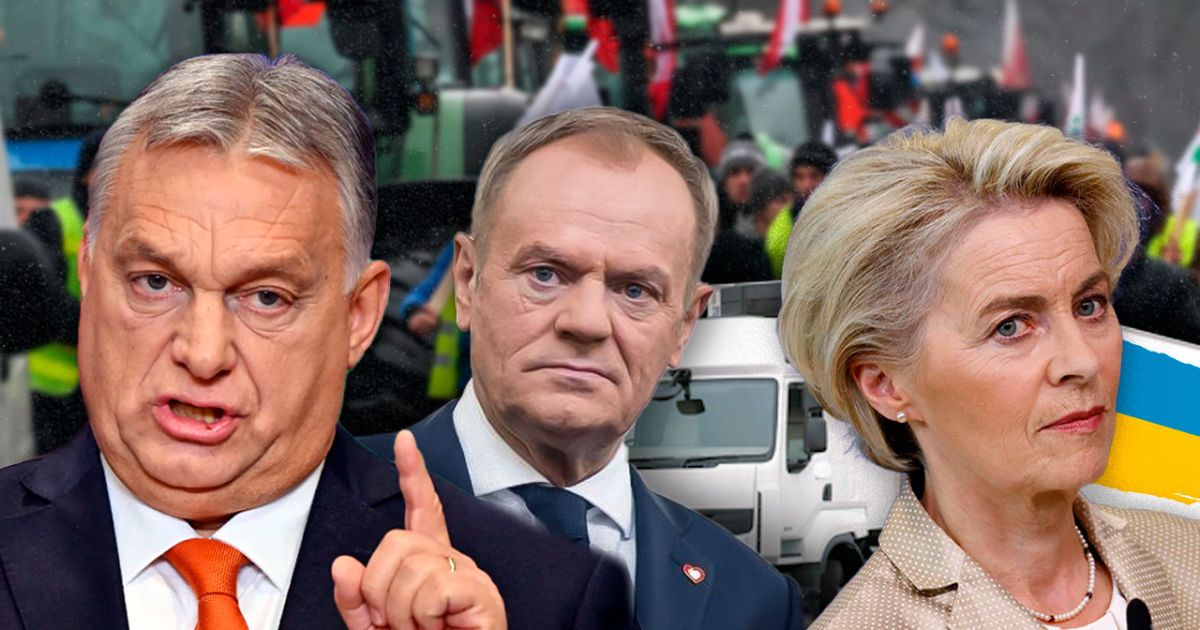
Kyiv has not imposed any restrictions on Polish imports, but it can do so, as well as give impetus to its claim to the WTO. Relevant decisions have been worked out by the relevant Ukrainian departments for a long time.
On Tuesday, February 20, Polish farmers are threatening to block all border checkpoints with Ukraine again for a whole month. Although the government of Donald Tusk said that it had agreed at least with the transporters that they would lift the blockade of the three crossing points by March 1, on Sunday, February 18, Polish farmers blocked the movement of trucks at the international crossing point "Dorogusk-Yagodin", and for the first time during the grain season crises tried to prevent the movement of trains and even passenger transport. According to the State Customs Service of Ukraine, the Polish police prevented this.
However, the problem with the border blockade is far from being resolved. Moreover, the farmers' protest, which may be supported by pro-Russian forces and money, is gaining a pan-European scale. At least, this is what the President of the Czech Republic, Peter Pavel, says about the farmers' protests in his country. But Hungarian Prime Minister Viktor Orban is already calling for the complete closure of the European market for Ukrainian agricultural products. Ideally, such disputes should be resolved by Brussels. However, as we can see, the EU structures have been unable to do anything for a year.
What is the current situation on the Polish-Ukrainian border? Why did Donald Tusk's government, seemingly more favorable to Ukraine than its predecessors, remove itself from solving the problem? But how will the situation develop further if Russia is really behind the actions of the border blockers? TSN
.ua
will tell in this text.
Grain and people: what the protesters demand
Local elections will be held in Poland on April 7 and 24. Therefore, the next blocking of the Ukrainian border by Polish transporters and farmers could again be attributed to politics, as was the case last fall on the eve of parliamentary elections in Poland. Then Ukraine really gained patience and waited for the pre-election hysteria in Poland to subside, and for a new coalition led by Donald Tusk to come to power after 8 years of rule by Yaroslav Kaczyński's conservative "Law and Justice" party, which liked to speculate on issues of common historical memory .
During the farmers' and transporters' protests on the border with Ukraine last fall and this winter, which have not stopped, many lamented the former government of Mateusz Morawiecki and the PiS, who deliberately did nothing to end the border blockade, which was clearly supported by pro-Russian forces , trying to put a pig on the next government. By the end of December last year, three Ukrainian drivers died in long queues at the border. Despite this, as well as the agreement to ban the import of Ukrainian wheat, corn, rapeseed and sunflower to Poland, official Kyiv did not make harsh statements, waiting for Donald Tusk's official visit to Kyiv on January 22 this year.
Less than a week before, Polish carriers promised to unblock checkpoints with Ukraine by March 1. However, farmers started their protest earlier this month, although Poland, and indeed the western border in general, has long ceased to be the main export "gateway" for Ukraine. And as of Sunday, February 18, 6 out of 9 checkpoints were blocked: "Yagodin", "Ustylug", "Ugryniv", "Rava-Ruska", "Sheghini" and "Krakivets". At the same time, according to the spokesman of the State Border Service of Ukraine Andrii Demchenko, 4 of them are the largest, through which trucks weighing more than 7.5 tons can pass.
But two incidents became the most blatant in the last week.
The first
happened in Dorohusk on the border with Ukraine, where Polish farmers dumped grain from Ukrainian trucks, which were sealed after the appropriate customs procedures and were transiting to Lithuania, directly onto the road. Moreover, Rafal Mekler, one of the organizers of the protests of Polish farmers, was the first to report this by posting a photo on his social networks. Back in November of last year, TSN.ua already wrote that he is the head of the Lublin branch of the pro-Russian Confederation party. The Polish police transferred the case of spilled grain to the prosecutor's office, the investigation is ongoing.
The second
incident also took place in Dorohusk on Sunday, February 18, when protesters did not allow passenger buses and the "Kyiv-Helm" train, where there were almost only women and children, to pass. After the intervention of the police and railway workers, the passage was unblocked. This was the first case of blocking passenger transport.
"Blocking the border is a direct threat to the security of a defending country. Such actions have a negative impact on our confrontation with a common enemy named Russia. Women and children who sought refuge from the war and for various reasons return home cannot become hostages business interests," said Deputy Prime Minister for Reconstruction Oleksandr Kubrakov after a conversation with the head of Poland's National Security Bureau, Jacek Severo.
Total blockade: why the Tusk government does nothing
According to Volodymyr Zelenskyi, what is happening on the border with Poland cannot be perceived as something normal or everyday. We need simple and clear justice.
"Only 5% of our agricultural exports pass through the Polish border. So, in fact, the situation is not about grain, but, rather, about politics. And near Kupyansk, not far from the border with Russia, where enemy artillery does not stop, the news from the border with Poland looks simple humiliating," President Zelenskyy said in his evening address on Monday, February 19, returning from Kupyansk.
What do Polish farmers demand?
Farmers' protests across Poland began on February 9. Their organization is supported by the National Union of Solidarity of Individual Farmers. The other day at the border, protesters unfurled offensive posters addressed to Ukrainians with the words:
"Go home, you ungrateful motherfuckers."
Polish mass media reported that not only all border checkpoints, but also railway junctions and seaports will be blocked from February 20. And we are not talking about Ukrainian grain anymore. Other positions were added to the "black" list.
They put forward three demands:
Farmers' protests with the blocking of border checkpoints, which have been ongoing since February 9, began shortly after the two-month blockade of the Ukrainian border by Polish carriers. They demanded the renewal of permits for Ukrainian drivers to work in the EU, saying that they could not stand the competition. That is, in fact, to return to quotas - the introduction of a certain fixed issuance of such permits per year. Although they were canceled by the EU in 2022. Currently, farmers are demanding similar measures from Brussels: to increase subsidies for rural support (almost half of the entire EU budget is already support for farmers in member countries, which kills competition) and to cancel the decision of the European Union to zero out all quotas and duties on Ukrainian exports, which should be extended at the level of Brussels until June 5.
On Friday, February 16, Ukrainian Minister of Agrarian Policy and Food Mykola Solsky discussed the situation at the border with his Polish counterpart Czeslaw Sekiersky, agreeing to continue negotiations this week. Previously, Sekiersky, like Donald Tusk himself, justified the protests of farmers who oppose the flow of goods from Ukraine and other non-European countries to the EU, including Poland, adding that Warsaw is analyzing the situation with Ukrainian exports, and , perhaps to the ban on the import of our wheat, corn, canola and sunflower, sugar, poultry meat and an additional 8% tax on oil will be added.
If we take the statistics, in January, almost $28 million worth of sunflower oil and $3.1 million worth of sugar were imported into Poland. Last month, we did not import poultry meat to Poland at all. And, for example, we export many times more of the same sunflower oil to Italy, the Netherlands, Spain and Turkey. Moreover, at present, Poland, like other European countries, is not the main export gate for us. After Ukraine was able to establish its own grain corridor last year (when Russia unilaterally withdrew from the Black Sea Grain Initiative, which was mediated by Turkey and the UN - ed.), our main exports go through the Black Sea.
A strange coincidence: work in favor of Russia
In addition, for some reason, Polish farmers talk exclusively about the ban on Ukrainian agricultural products. What about Russian and Belarusian? They still freely enter the EU markets in sufficiently large volumes through Latvia and Greece, because Brussels has not introduced appropriate sanctions. Ukrainian mass media reported that Kyiv has already prepared all the necessary decisions regarding the ban on the import of certain types of Polish products into Ukraine. In addition, let's not forget that last fall, Ukraine suspended its claim to the WTO against Poland, Hungary, and Slovakia for banning the export of Ukrainian wheat, corn, rapeseed, and sunflower, which violates EU legislation.
However, as we understand, these are extreme measures. So far, the relevant Ukrainian government structures are trying to solve the problem through negotiations. But, politically, we see that, for example, Donald Tusk's government not only does nothing, but also supports Polish farmers who block the Ukrainian border. So how do we respond to this? According to Yevhen Magda, director of the Institute of World Politics, Ukraine needs to react as balanced as possible and realize that, on the one hand, this problem is part of a general European trend, and on the other hand, it depends on two things.
"This is reflexive management carried out by the Kremlin. Although Polish politicians do not really want to admit it. But today it is actually a fact. If we look at the chronology of Rafal Mekler's actions, we will see that it clearly coincides with the timing of changes in power, holding local elections (now in Poland - ed.), etc. However, we must look for ways to dialogue even when it seems extremely difficult, being realists and pragmatists. We had illusions that Tusk would come - order would be brought, that the Polish prime minister would work in the interests of Ukraine. But his visit to Kyiv at the end of January showed that he thinks first of all about his own political interests (and this is normal), and does not want to expose himself to criticism from his political opponents. Therefore, expect some tough actions by the Polish authorities before the local elections April 7 is not worth it," Yevhen Magda said in a comment to TSN.ua.
TSN.ua already wrote that long before February 9, when Polish farmers announced their protest action with a blockade of the Ukrainian border, similar actions swept through France. Moreover, precisely on February 1 - the day of the extraordinary EU summit, at which the leaders of the member states decided to allocate a long-term macro-financial aid package to Ukraine worth 50 billion euros until 2027, farmers on tractors staged a protest in Brussels. And this could be called a coincidence, if Russian-speaking people in clothes with Russian inscriptions were not noticed at this farmers' protest in Brussels. Already now, as we can see, the pro-Russian Viktor Orban is calling for the EU borders to be closed for all Ukrainian agricultural exports. And, judging by the information in the European media, the European Commission will make concessions to such countries as Poland, Hungary, and Slovakia, limiting the import of not only Ukrainian wheat, but also other types of our agricultural products.
If the border blockade continues, according to Danylo Hetmantsev, head of the Verkhovna Rada Committee on Finance, Tax and Customs Policy, the Ukrainian budget will lose UAH 7.7 billion. However, Poland, for its part, suffers considerable losses from the blockade of the Ukrainian border. Last year, the farmers' protests were supported by the "Deceited Village" movement, which closely cooperates with the pro-Russian Confederation party, whose ratings, according to recent opinion polls, are growing.
In addition, candidate of political sciences, international expert Stanislav Zhelikhovsky reminds that Minister Czeslaw Sekerskyi is a representative of the Polish Peasant Party, which from the very beginning of these protests in 2023 supported restrictions on the import of Ukrainian agricultural products. Moreover, speaking at the Munich Security Conference, the Minister of Foreign Affairs of Poland, Radosław Sikorski, emphasized that, as a sign of solidarity with Kyiv due to the full-scale Russian invasion, Ukraine was admitted to the single European market in 2022.
"That is, the actual Polish side says that Ukraine did not quite fairly get access to the single market without preliminary negotiations and a transition period. On the other hand, Donald Tusk is in a kind of trap. He wants to solve this problem, being very unhappy that he got one" inheritance" from PiS. However, his government coalition is very fragile (in addition, it includes the Polish Peasant Party, whose name is clear whose interests it protects - ed.), and Tusk wants to preserve it and must balance it. There as well as Michal Kolodzejczak from the Agrounia party (he went to the Diet on the lists of Tusk's Civic Coalition - ed.), who is Sekersky's deputy minister," comments TSN.ua Stanislav Zhelikhovskyi.
On Tuesday, February 20, Czeslaw Sekerski invited Polish protesters to negotiations, noting that the ministry wants to develop a bilateral agreement with Ukraine, which would extend the import ban to sugar, poultry meat, eggs, soft fruits, honey, apple juice and oil Therefore, Ukrainian experts are already warning that it is necessary to prepare for a long "agrarian" confrontation with Poland, even if Russia stops fueling these farmers' protests.