 Home
Home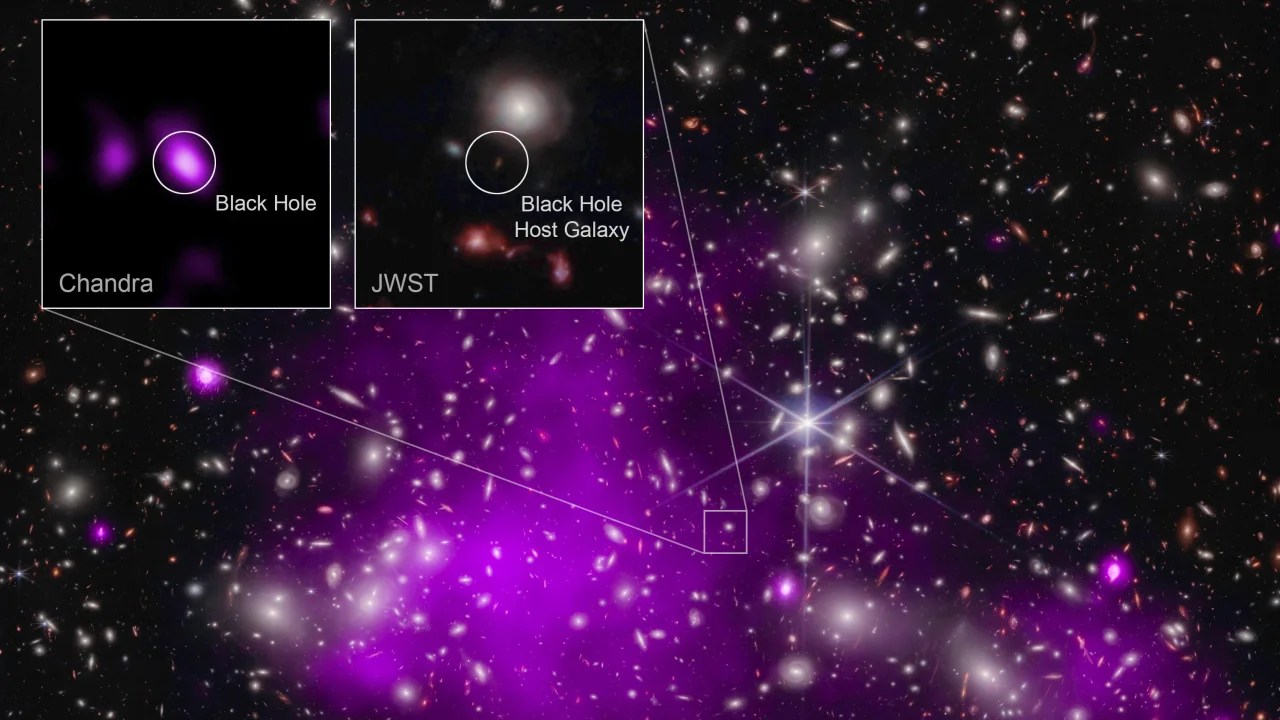
NASA Announces Discovery of Unprecedented Black Hole 1:18
(CNN) -- Two powerful NASA telescopes have detected the oldest and most distant black hole ever found.
Data collected through energetic X-rays by the Chandra X-ray Observatory and the James Webb Space Telescope have helped astronomers detect the mark of a growing black hole within the early universe, just 470 million years after the Big Bang that occurred 13.800 billion years ago.
The discovery, revealed in a study published Monday in the journal Nature Astronomy, may help astronomers reconstruct how some of the first huge black holes in the cosmos formed.
- We're Made of Stars: The Long Journey From the " Big Bang" to the human body
"We needed the Webb telescope to find this remarkably distant galaxy and Chandra rays to find its huge black hole," the study's lead author, Akos Bogdan, said in a statement. "We also took advantage of a cosmic magnifying glass that increased the amount of light we detected." Bogdan is an astrophysicist at the Harvard-Smithsonian Center for Astrophysics in Cambridge, Massachusetts.
He was referring to an effect called gravitational lensing, which occurs when closer objects (in this case a galaxy cluster) act as a magnifying glass for distant objects. Gravity warps and amplifies the light from distant galaxies in the background of whatever it is magnifying, and allows us to observe celestial features that would otherwise be invisible.
advertising
Astronomers detected the black hole in a galaxy called UHZ1. At first glance, the galaxy appeared to be heading in the same direction as a galaxy cluster known as Abell 2744, which lies about 3.500 billion light-years from Earth. However, data collected by the Webb telescope showed that UHZ1 is actually much farther away, located beyond the cluster, 13.200 billion light-years from Earth.
- Webb Telescope Detects Supermassive Black Hole Formed More Than 13 Billion Years Ago
A light-year, equivalent to 9.4 trillion kilometers, is the distance a ray of light travels in a year. Given the distance between Earth and objects from the early days of the universe, when telescopes like Webb observe this light, it's like looking into the past.
The team used the Chandra Observatory to detect superheated gas releasing X-rays inside UHZ1, which is the telltale sign of a giant black hole that is growing in size.
The detection was made possible by the Abell galaxy cluster, which intensified by four times the light from the UHZ1 galaxy and the X-rays released by the black hole.
Decoding a Cosmic Mystery
Astronomers believe the discovery will help them better understand how huge black holes appeared and reached their monstrous masses so soon after the beginning of the universe.
The researchers want to know if these giant celestial objects formed when huge clouds of gas collapsed or if they were the result of the explosions of the first massive stars.
"There are physical limits to how fast black holes can grow once they've formed, but those born with higher mass have an advantage. It's like planting a sapling, which requires less time to grow into a full-sized tree than if you started with just one seed," said Andy Goulding, an astrophysical sciences researcher at Princeton University in New Jersey.
- Scientists say they've discovered what's hidden inside a black hole
He is a co-author of the Nature Astronomy paper and lead author of another paper on the UHZ1 galaxy published in September in The Astrophysical Journal Letters.
The team reporting their results in the Nature Astronomy paper found that the mass of the distant black hole is similar to the total mass of all the stars within the host galaxy. The mass is between 10 million and 100 million suns, depending on the brightness and energy of the X-rays it emits, the researchers said.
Potential Black Hole Theory
Normally, black holes located at the centers of galaxies only have about 0.1% of the mass of stars within their host galaxy.
The unusual black hole could be a "large black hole" that formed when a huge cloud of gas collapsed, as Priyamvada Natarajan, a co-author of both studies and a professor of astronomy and physics at Yale University in New Haven, Connecticut, said in 2017.
"We believe this is the first detection of a 'large black hole' and the best evidence yet that some black holes form from massive clouds of gas," Natarajan said. "For the first time we are seeing a brief stage in which a huge black hole weighs about as much as the stars in its galaxy, before being left behind."
Black HoleBig BangNASATelscope Webb