 Home
Home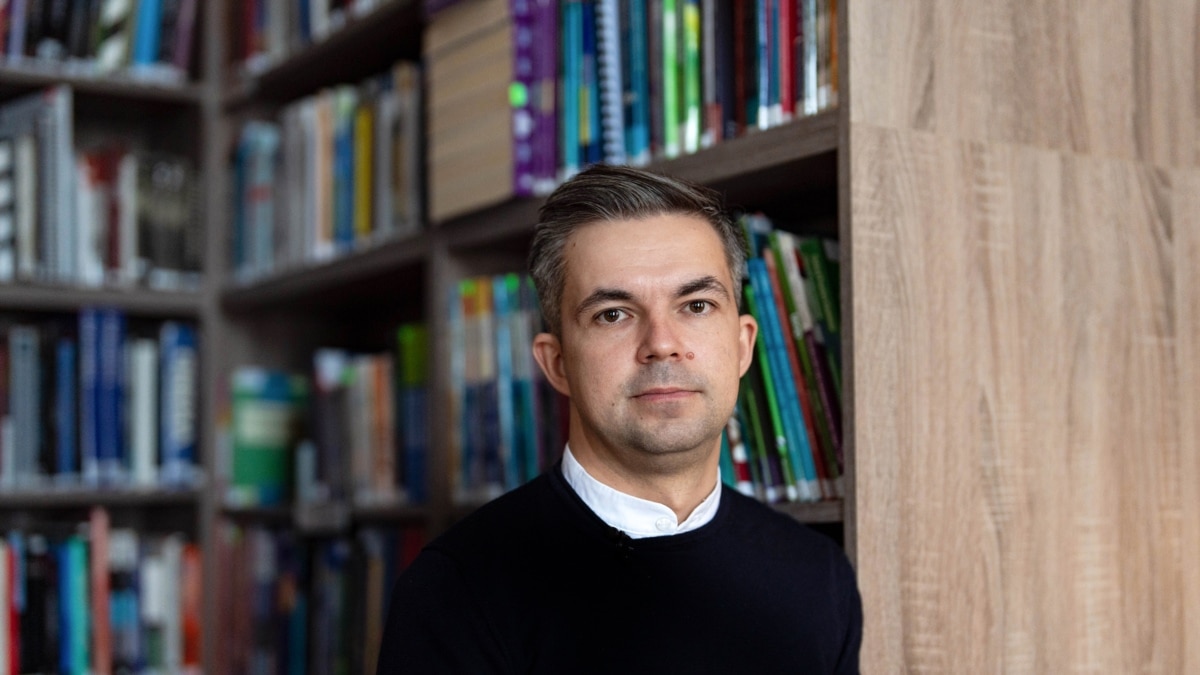
Sasha Filipenko
is a Belarusian Russian-speaking writer. He was born in Minsk, wrote scripts for programs on Russian television, and has been living in Switzerland for the last few years.
At home, a criminal case was opened against Filipenko, probably because of his oppositional views: he participated in protests against the Lukashenka regime in Minsk in 2020, and after the start of the full-scale Russian invasion of Ukraine, he condemned the actions of Moscow.
The case concerning the writer became known when his father was detained in Belarus in November 2023. At the police station, he signed a report on opening a criminal case against his son, after which he himself was arrested for 13 days.
It is still unknown under which article the case was initiated. However, during the interrogation, according to his father, printed photos of Sasha Filipenka with the President of Switzerland, of Tikhonovsk, with the Minister of Culture of the Federal Republic of Germany were placed in front of him. The father was pointed at these photos, asked whether his son was proud of Belarus and whether he was going to return, the writer said.
"Nastoyasche Vremya" TV channel spoke with Filipenko about his criminal persecution in his homeland, his books and whether Lukashenka's regime succeeds in dividing Belarusians.
- Let's start by talking about your criminal case: is there any movement on it?
- I don't know anything about her. We know that the house was searched, we know that the search was within the scope of my criminal case. Dad didn't see what the article was: he only saw the long article number. And he was interrogated by the investigator, but we still don't know what the case is. As if some more details should have been revealed, but I don't know anything.
Dad spent 13 days in a special reception, and he was released. And in general, it was immediately clear that there were no complaints against him, that all this was in connection with the case in relation to me. I don't know if Dad has "Stockholm syndrome" or not, but he says he was treated as well as possible to be treated well in Belarusian prisons. But he says that it was immediately clear that all the questions were for me.
- Isn't it difficult morally that your father is repressed, as it were, because of you, to take revenge on him for his son?
- It is definitely difficult. But it seems to me that this is a situation in which not only my family found itself: thousands of Belarusians found themselves in it. And we need to keep talking about it, because the only thing these people want is for us to start being silent. It's definitely a difficult situation, but it's definitely the only right thing to do to keep talking about it.
- Now the level of destruction of journalism and culture in Belarus is simply phenomenal. Can you track the trend somehow? What to expect? Because you are a part of Belarusian culture and journalism in particular?
- It seems to me that everything will continue to happen. They will find the last journalists who do something, they will find the last theatergoers. It seems to me that the repression is developing so powerfully that people who support the regime will begin to fall under this repression, and we can already see that they are beginning to fall.
After all, when the wheel of repression is spinning, it is clear that he does not have any logical explanations for these repressions. And it seems to me that the moment is coming when all journalism inside Belarus, all people who actively did something, are now forced to be in such an internal exile. It seems to me that supporters of the regime need to prepare. Because the security forces need to show that they continue to work, and they will find enemies now among their own as well.
- If we talk about literature, about the evolution of your readers over these three years: can we say that the majority of readers are emigrants who moved and read in Russian or Belarusian? Or is it still a foreign audience reading in a foreign language?
- I don't know, it's difficult for me to answer this question, because I know that I am still read in Belarus. I know that I am read in Ukraine, Russia, Lithuania, and Europe. It's just that there are probably more readers in Europe, because books are being translated into new and new languages. But I want to believe that my main reader is still in Belarus.
- You can recall the story that the pre-trial detention center on Akrestin in Minsk had your book. Can you tell this story?
- I don't know much. I know that when a man was released, he told me that this book helped him a lot because it was read and passed from cell to cell. I have no idea how it was done, just technically how the book could end up there, how it was read. But this is definitely the main award that a writer can receive: not a literary award, but when you understand that the book helps people. That it is such a therapeutic effect, but it is something very important. This is some important recognition that you receive.
- How, in your opinion, is it possible to preserve psychologically healthy relations between Belarusians who are inside the country and those who have left?
- I don't know, I don't see a problem in this. In any case, to communicate with your friends who remained, or with loved ones who remained in Belarus. It seems to me that this is simply a question of mutual respect, a question of not shifting the blame to those who stayed or to those who left. Understanding that many of those who stayed stayed there for a reason, and many of those who left left for a reason.
And in this sense, it seems to me that if people will listen to each other, will go towards each other, it seems to me that this problem will be to a lesser extent or will not be so acute. And Belarusians, it seems to me, are great in this sense and know how to listen to each other. Now I see that from time to time spears break on Facebook, but that's what Facebook is for. It seems to me that all the hottest minds and all the most self-confident people appear precisely in the comments on Facebook. But I don't see this problem as strong when I just communicate with people I know or with loved ones.
For sensitive topics,
write to us here.
SAFE