 Home
Home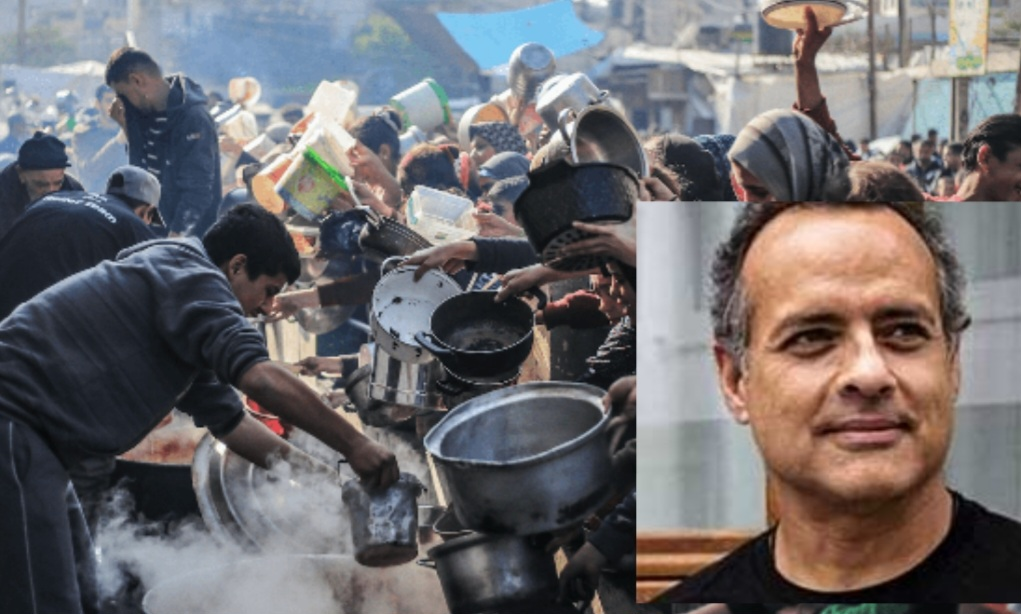
Indian historian, editor and journalist, gave his opinion on the Israeli genocide of the People of Palestine. Photo: The Citizen
In a speech in Rome, Italy, the head of the
United Nations World Food Programme, Cindy McCain
, declared: “If we do not exponentially increase the volume of aid reaching the northern areas of Gaza, “
famine "It's imminent
. It's imminent." More than
30,000 people
have been killed in Gaza by Israel's genocidal war, and those who survive are on the brink of starvation.
Palestine's Permanent Observer to the United Nations, Riyad Mansour
, said more Half a million people are “one step away from starvation.” “What it means for mothers and fathers to hear their babies and children cry with hunger day and night, without milk, without bread, without anything,” he added. In fact Babies and children have already begun to die due to the famine-like conditions in Gaza. With Ramadan already underway, the situation is not only physically acute, but also mentally torturous.
Currently, there are
2,000 medical workers
doing their best to provide basic medical care in northern Gaza. They are working without access to any hospitals and often without electricity or water, including a very limited supply of medicines. Now, the Palestinian Health Ministry in Gaza has stated that these workers are also in a desperate situation. The staff, the Ministry said, “will begin Ramadan without Suhoor or Iftar.” “Doctors will die. The nurses will die. And the world will witness the greatest number of
victims of hunger in the coming days
,” declared Ashraf al-Qudra, spokesperson for the Ministry.
War crime
In June 1977, at a conference on humanitarian law in armed conflict, United Nations Member States expanded the Geneva Conventions (1949) to add Protocol II. Article 14 of that protocol says that “[t]he siege of civilians as a method of combat is prohibited.” The belligerent power is “prohibited from attacking, destroying, removing or disabling” any “object essential for the survival of the civilian population, such as food, agricultural areas for food production, crops, livestock, facilities and reserves of drinking water and irrigation works. Two decades later, when UN Member States drafted the Rome Statute (1998), they added a section on starvation under the heading of war crimes (article 8); “intentionally using the starvation of the civilian population as a method of warfare by depriving them of objects essential to their survival, including deliberately obstructing relief supplies” is a war crime. The Rome Statute is the treaty that created the International Criminal Court (ICC), which has until now remained silent about its obligations to act under its own founding document.
On February 29, trucks with humanitarian aid arrived in northern Gaza. As desperate people ran toward those trucks, Israeli soldiers fired on them, killing at least 118 unarmed civilians. This is now known as the Flour Massacre. Following the massacre, 10 UN experts issued a forceful statement stating: “Israel has been intentionally starving the Palestinian people of Gaza since October 8. “Now it is attacking civilians seeking humanitarian aid and humanitarian convoys.” The UN special rapporteur for food, Michael Fakhri, who signed that statement, later expanded on this accusation against Israel. “Israel,” he told the UN Human Rights Council, “has waged a campaign of hunger against the Palestinian people in Gaza.” These statements are very direct. Words like “intentionally” and phrases like “hunger campaign” directly accuse Israel of war crimes based on Protocol II and the Rome Statute.
Fakhri focused on Gaza's fishing industry, which had provided significant food security to the 2.3 million Palestinian people living there. “Israeli forces,” he said, “have decimated the Gaza port, destroying every single boat and fishing shanty. In Rafah, only two of the 40 ships remain. In Khan Younis, Israel destroyed approximately 75 artisanal fishing boats." This destruction, Fakhri said, has pushed Gaza “into hunger and starvation.” “In fact,” he added, “Israel has been strangling Gaza for 17 years through a blockade that includes denying and restricting artisanal fishermen access to its territorial waters.”
At the UN General Assembly, Palestinian Riyad Mansour stated that Israel has bombed “all bakeries and farms, destroying livestock and all means of food production.” In the first month of bombing, Israel bombed the main bakeries in Gaza City. In November 2023, Abdelnasser al-Jarmi of the Gaza Strip Bakery Owners Association stated that bakeries have been unable to operate due to lack of fuel and flour. As a result of the lack of bread, families have begun to collect an herb called
khubaiza
(or
Malva parviflora
) and boil it as a main meal. “We are dying for a piece of bread,” said Fatima Shaheen as she prepared a meal for her two children and their children in northern Gaza.
Crosses
Israel has refused to fully open the Gaza border crossings at Beit Hanoun and Karem Abu Salem, as well as to allow the full opening of the Rafah border crossing, which links Gaza to Egypt. Given that these land crossings are closed, and that Israel destroyed the Yasser Arafat International Airport in 2001, there are no easy solutions to getting food aid to Gaza. Delivering food and supplies by air is not enough, in fact it is a drop in the ocean (which is where some of the aid packages landed).
Now there is talk of building maritime corridors, but since Israel has bombed the port of Gaza it is not an easy option. That the United States said it would build a temporary dock off the coast of the southern half of Gaza is ridiculous. It would be much easier to open the Rafah border crossing to allow at least 500 trucks a day into Gaza. But Israel will not allow this option. International law is clear as day on the point of starvation as a war crime. There are no gaps in Protocol II (1977) or the Rome Statute (1998). Friends of Gaza are finding this month of Ramadan more difficult than any before. Hunger is their general condition. But unlike other Ramadans, there is no food in the early morning (Suhoor) or in the evening (Iftar). There is only the perennial noise of Israeli fighter planes, reflected in the hungry moans of their stomachs.
This article was produced for Globetrotter.
Vijay Prashad is an Indian historian, editor and journalist. He is a staff member and chief correspondent for Globetrotter. He is editor-in-chief of LeftWord Books and director of the Tricontinental Institute for Social Research. He has written more than 20 books, including The Dark Nations and The Poor Nations. His latest books are Struggle Makes Us Human: Learning from Movements for Socialism and The Withdrawal: Iraq, Libya, Afghanistan, and the Fragility of American Power (with Noam Chomsky).
(Taken from El Ciudadano.Com)